Revealed: The Industries Using AI the Most on LinkedIn in 2025
Try Publicate For Free Today
Start Now

Publicate has analysed almost 1000 LinkedIn posts in order to uncover the industries and seniority levels that are relying on AI-generated content the most.
Since the widespread rollout of accessible Artificial intelligence, AI has become a routine part of how professionals communicate in online spaces. The public availability of AI tools is quickly shaping how professionals engage with industry, from thought leadership posts to company updates. Nowhere is this online shift more visible than on LinkedIn, a platform that relies heavily on authoritative and insight-driven content. As AI tools are becoming easier to use, they are influencing how individuals develop their personal brand and maintain visibility in competitive business spaces.
With this in mind, Publicate carried out an intense study in order to better understand this shift. We have analysed close to 1000 LinkedIn posts that have been published by professionals across eight major UK industries. Each post studied was evaluated using a leading AI content detection tool in order to expertly determine the likelihood that AI played a role in the content creation. The research reveals which industries rely the most heavily on AI as well as how AI usage varies by seniority level. These insights are important as they highlight larger changes in workplace communication and expectations regarding online brand performance.

The Publicate analysis and data discovered a noticeable hierarchy in the reliance on AI across a variety of sectors. The data uncovered that industries that are often seen as fast-paced, data-driven or highly competitive tend to use AI the most, while sectors built on interpersonal trust and human expertise show more restraint when it comes to AI usage. The financial sector has emerged as the highest user of AI tools in LinkedIn content, with almost three quarters of finance-based posts reflecting signs of AI involvement. In contrast, industries in the healthcare and HR sector have a significantly lower reliance on AI which reflects the genuine value placed on personal voice and authenticity in these fields.
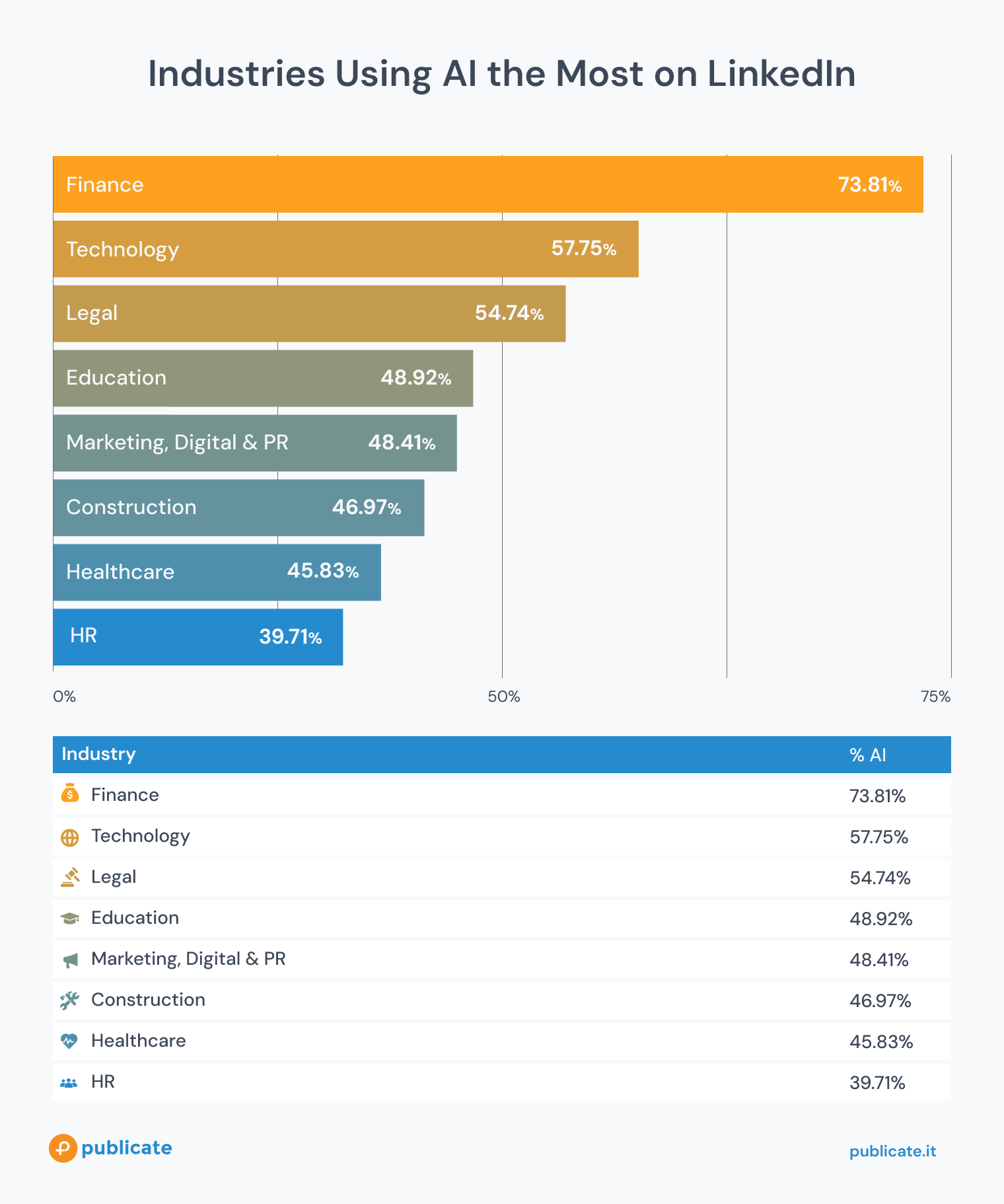
Based on the data collected by Publicate, finance professionals showcase the highest likelihood for using AI in their LinkedIn posts. This could be a sign of professional pressure within the sector, as professionals are expected to deliver rapid insights, maintain a polished online presence and keep up with ever-evolving industry trends. It is also important to note that the technology and legal industries also rank high in AI usage which aligns with their analytical and documentation-heavy workflows. All of this demonstrates the increasing normalisation of AI support in everyday workflow tasks.
As stated previously, healthcare and HR show considerably lower usage when it comes to AI reliance on LinkedIn. These industries are about personal expertise, safeguarding of relationships and trust-based communication. As a result, there seems to be much greater caution when it comes to taking on AI assistance for professional messaging. When it comes to the middle-ground, we see the construction and education sectors. This reflects a blend of traditional communication expectations as well as the growing adoption of digital tools.
The results of the study suggest that industries with a strong emphasis on authority, precision and output volume are more likely to incorporate AI into content creation, whereas fields where personalisation and trust are vital, are much slower to adopt AI-generated writing or content.

Create newsletters faster, together.
Design with 300+ professional templates, drag-and-drop media, and unlimited teammates. Build once, reuse blocks, and ship beautiful emails in minutes.
The Publicate LinkedIn study also reveals that AI usage is not the same across different career stages. Based on the study, mid-level professionals are the most likely to make use of AI in their LinkedIn posts, followed closely by senior executives and entry-level employees. This pattern highlights that pressure points exist at both ends of the career spectrum. Mid-level staff may feel the need to appear visible, informed and credible on a consistent basis, while entry-level workers are using AI tools to compensate for limited experience. Senior executives are also facing constant demands when it comes to their time, and also show a high reliance on AI support to meet these demands.
Senior and junior team members are displaying a comparatively lower usage of AI which suggests that they may rely more on expertise and internal communication as opposed to public posting, or simply have a preference for crafting their own industry voice.
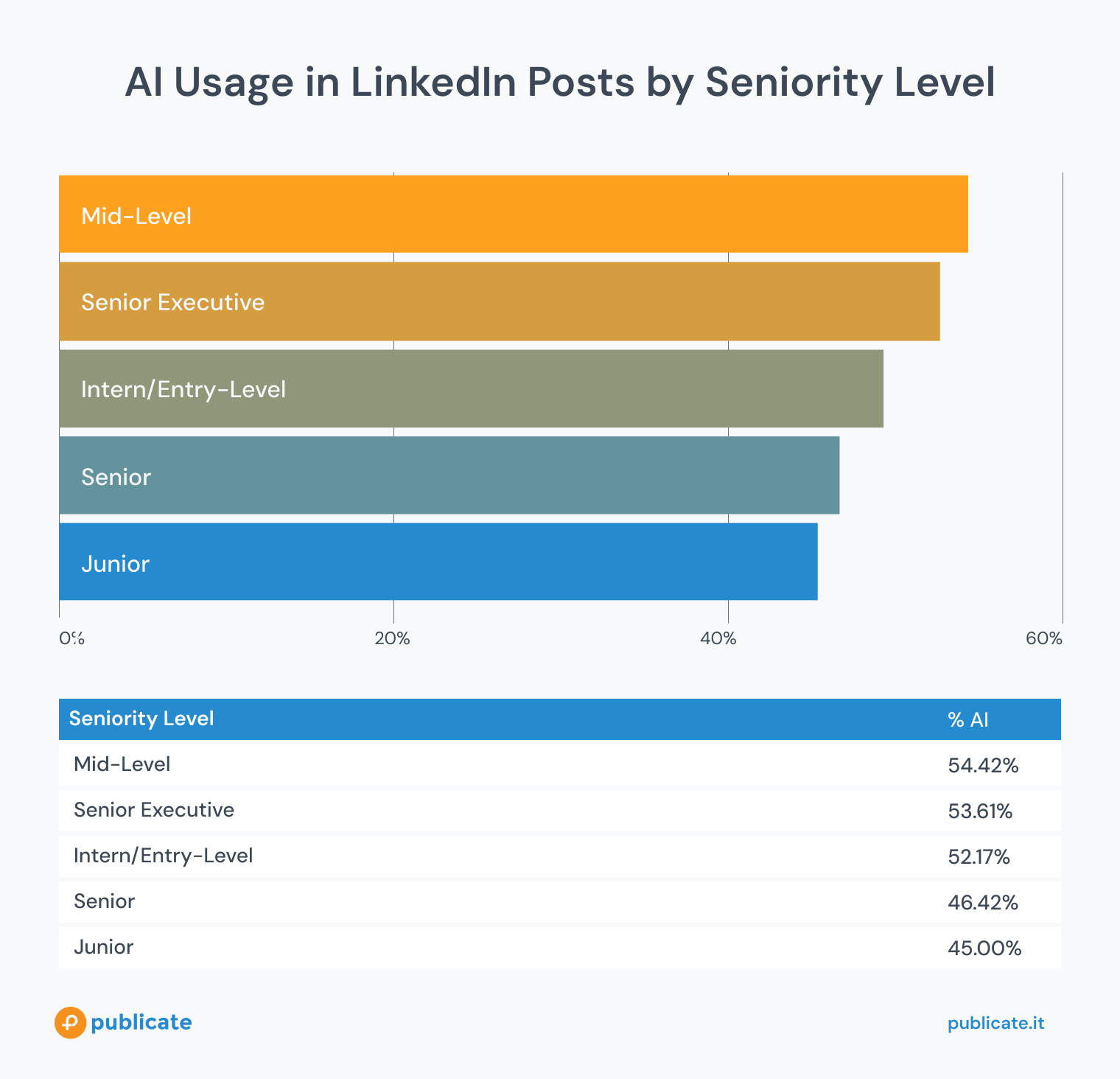
Mid-level employees are leading AI usage on LinkedIn and this is likely due to workload, performance expectations and the need to show career progression through online thought leadership. Senior executives follow closely which may reflect both the efficiency benefits AI offers as well as the scale of their ability for communication output.
Entry-level workers also show high usage which highlights the role of AI as a supporting tool for emerging professionals who may lack confidence in writing or feel pressure to match the polished content they see from more experienced peers. Senior and junior professionals showcase lower reliance on AI tools which may indicate greater comfort in independence or a reduced need to keep-up a strong online presence.
The study brings to light a broader shift in how professionals are presenting themselves online. AI is becoming a productivity tool as well as a strategic asset to be used for shaping personal voice, expanding thought leadership and maintaining consistency across professional channels. As industries embrace AI at different speeds, questions around authenticity, transparency and the role of human insight will inevitably continue to grow and spark conversation.
For professionals, the challenge will be balancing efficiency and output alongside genuine personal expression and leadership. For organisations, the focus will be understanding how AI influences workplace culture and external messaging. What is clear is that AI will continue to transform LinkedIn content and frequency of professional communication in the years to come.
Publicate will continue to analyse these trends to provide deeper insight into how AI is reshaping the future of communication at every level of industry and seniority.
Turn opens into action.
Track performance in Gmail, Outlook, and anywhere your emails are read. Get clear insights, actionable recommendations, and downloadable reports to grow engagement with confidence.


Beautiful Designs
Powerful Analytics
Export Emails Anywhere
Built for Teamwork