Create an HTML Newsletter: The No-Code Step-by-Step Guide
Try Publicate For Free Today
Start Now

Today, teams are looking for polished newsletters that look professional while driving recipients to take action. To this day, email newsletters are still one of the most effective ways for organisations to communicate with their customers, clients and employees. And as communication evolves, people no longer tolerate blocks of plain text and a company logo. They want a newsletter that feels polished, is easy to read, visually consistent and designed to guide them to take action.
This is where HTML newsletters come into play.
Most of the newsletters received today are HTML newsletters. They are made up of branded layouts, images, structured sections, and clear calls to action that make information easier to understand and act on. The issue is that creating HTML newsletters manually can quickly become overly complicated.
Building emails in HTML involves coding, responsiveness, image sizing, email compatibility, layout structure and testing. Even the smallest formatting decision can affect how an email looks across platforms.
For a lot of teams, the issue is not writing the content, rather it is turning content into an email that looks professional and performs well. This is why more organisations are using newsletter builders rather than creating HTML emails from scratch. Rather than relying on designers or manual HTML editing, teams can build branded newsletters that maintain consistency across campaigns - faster.

To create an HTML newsletter, choose a responsive email template, customise it with your branding and content, add images, links, and CTA buttons, test how it renders, then export or send it through your chosen email platform.
While the process sounds simple and straightforward, the implementation is often where teams will lose an enormous amount of time.
As opposed to standard website pages,. HTML newsletters require work inside email environments, and all behave differently. Different platforms, from Apple Mail and Outlook to Gmail, can render the same email differently, which means layout, images and styling will require more strategy than many consider.
The best and easiest way to create an HTML newsletter is to use a purpose built email builder, rather than trying to code from scratch or trying to build it manually.
With Publicate, teams are able to create branded and highly responsive HTML newsletters by using templates, drag-and-drop editing, content blocks and built in CTAs. This means they don't have to rely on designers and developers to get the job done. With this in mind, instead of manually coding and testing emails, teams are able to create HTML newsletters simplyvisually, thatwhile maintainning consistency and render well with every send across any platform.
An HTML newsletter is an email newsletter that is built using HTML code which allows for a more visual, branded and interactive experience rather than plain text. An HTML newsletter can include images, stylised headers, layouts, buttons, and other visual elements that will improve the readability and engagement of the email.
Most branded newsletters received today are HTML newsletters. Whether they are for a company update or product announcement, HTML gives teams way more control over how their emails look and most importantly, perform.
One of the greatest advantages of creating an HTML newsletter is the ability to create consistent experiences with every single send. Teams are able to apply branding, structure and make calls to action visible without relying on basic email formatting.
With the above in mind, it is easy to see why HTML newsletter templates are widely used across organisations.
Not all newsletters require over-the-top design. Plain text emails absolutely still have their place, particularly for quick updates or messages where simplicity matters most.
However, when the goal of the newsletter is to create a professional exchange that is branded and encourages action, HTML newsletters are significantly more effective and flexible. The primary difference comes down to the control you have over presentation and overall reader experience. Let’s take a look:
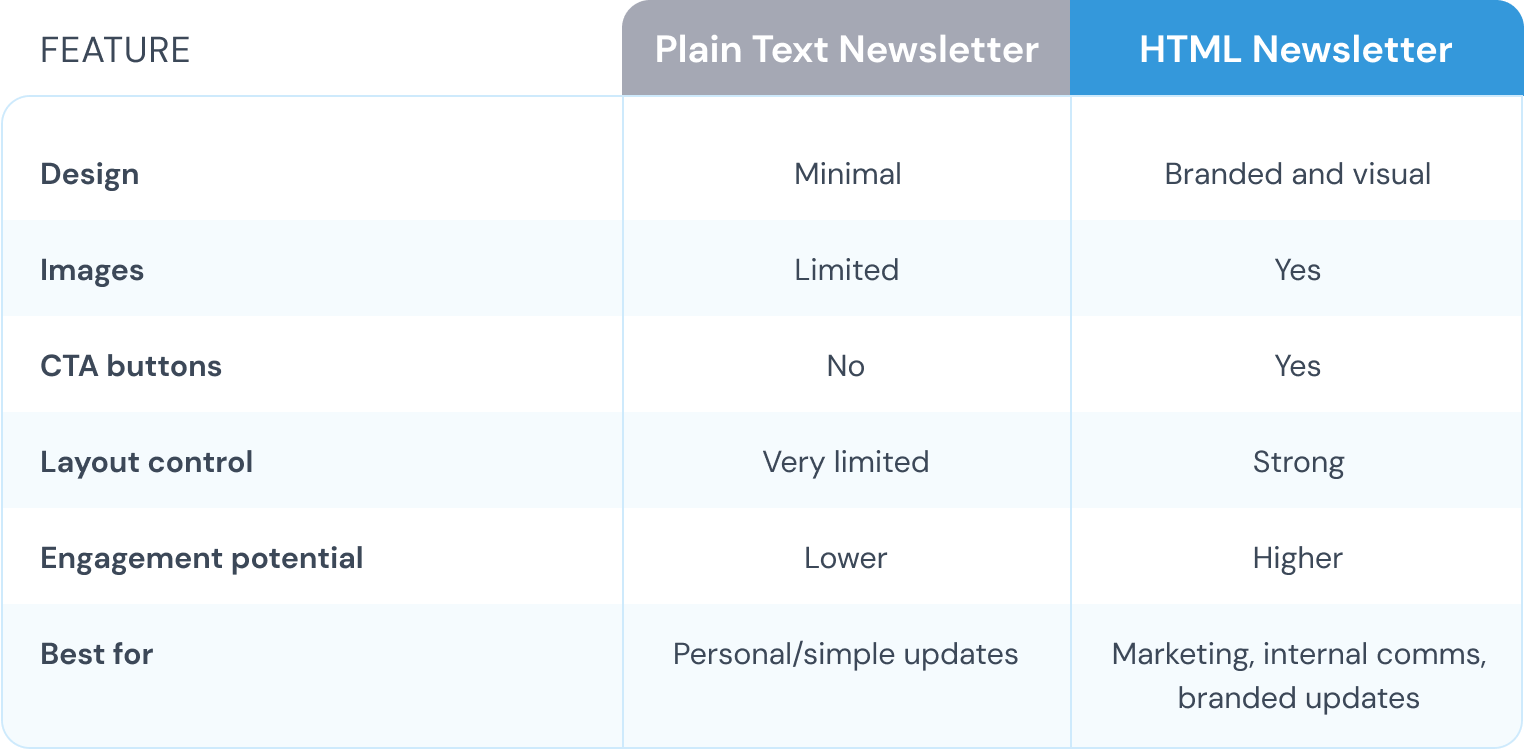
While plain text newsletters can be a bit more personal and lightweight, HTML newsletters empower teams with opportunities to create consistent and professional communication. As HTML newsletters support branded layouts, visuals and CTA buttons, they are best for internal communications, marketing, company wide updates and client communication.
It is also important to note that HTML newsletters make it easier to maintain brand consistency and approve click-through rates while creating content that is easy to scan across all devices and platforms. For teams that deal with regular communication at scale, this is the difference between sending an update and creating engagement and experience.
If your goal is to send information from one inbox to another, then a plain text email may be enough. However, if you want to create professional communication, an HTML newsletter offers more flexibility:
Stronger Brand Identity:
This is because HTML newsletters give teams more control over how content is presented. Instead of relying on basic formatting, teams are able to create structured and visually interesting newsletters that are easier to read and act on.
One of the greatest advantages of creating an HTML newsletter is consistency. HTML newsletters allow teams to use logos and visual styling that makes communication recognisable instantly. Instead of every email feeling disconnected, branded newsletters create a more cohesive experience across campaigns and communication. All of this is especially important for organisations sending regular newsletters across teams or audiences.
Better Engagement:
HTML newsletters are designed to make information easy to consume. Headings, images, content sections and visual hierarchy help readers scan the content instead of working through large blocks of text. When content feels easier to work through, people are more likely to engage and take action.
This is useful for internal newsletters, company updates and content-heavy communication where readability directly affects performance.
More Effective CTAs:
Calls to action are easier to showcase in an HTML newsletter than in a plain text email. This goes without saying.
HTML allows teams to use buttons, links, featured sections and visual prompts to take action. No matter the goal of the newsletter, a strong CTA guides engagement more effectively.
More Creative Content:
HTML newsletters create more opportunities for dynamic and engaging content.
Teams can include:
This flexibility helps organisations create newsletters that are more polished and adaptable without increasing complexity.
Trackable Performance:
HTML newsletters are also able to create opportunities to understand how people are engaging with your content.
Publicate empowers teams to track:
And all this can be done even when emails are sent through Gmail or Outlook.
Creating a manual HTML newsletter may sound manageable, but this is until teams actually begin the process of building one. Unlike standard websites, HTML email code follows a lot of different rules. By this we mean that elements that may work easily on a website, may not behave the same way inside of an inbox.
Email clients also render HTML differently. This means that the same HTML newsletter can appear differently in Outlook compared to Gmail. This creates added work when it comes to layouts, spacing, images and formatting.
Teams creating HTML newsletters manually will often have to consider:
Even small changes to layout can lead to many rounds of testing and adjustment - and mistakes. This is why most teams won’t code newsletters manually. They prefer a faster and more reliable way to create HTML newsletters.
With Publicate, teams are able to create branded and responsive HTML newsletters using templates, drag-and-drop editing and content blocks without relying on developers or manual coding.
Begin with a template that matches the kind of newsletter you are creating. The correct structure will make building HTML newsletters faster and will remove the pressure of starting from scratch. It also helps to maintain consistency when sending future mails.
Choose your HTML newsletter template based on purpose such as:
These kinds of templates reduce blank-page friction and improve consistency.
Once you have chosen your HTML newsletter template, the next step is to make it recognisable and consistent with the rest of your communication.
Your branding should be consistent across every newsletter and should include:
With Publiate's brand kit, teams are able to apply brand assets across newsletters without having to manually update styles every single time. This makes the entire process faster and more consistent.
Once your structure and branding have been put in place, it is time to build the newsletter. A good HTML newsletter should be easy to scan and engage. With this in mind, most newsletter should include:
Try to keep your content structured and focused. Using content blocks can make it faster to create HTML newsletters consistently without having to rebuild the layout every time.
Even the best content can be difficult to engage with if the layout becomes overwhelming and hard to navigate.
When creating an HTML newsletter it is important to focus on information that is easy to scan rather than trying to fit too much in an email.
A powerful newsletter layout should include:
Spacing, visual flow and structure will help guide readers through the mail. In most cases, the simpler layouts will perform better as readers can quickly digest the message and take action.
Before you send your HTML newsletter it is important to make sure it works well across all devices and inboxes. With this in mind, a good HTML newsletter must include:
Taking the time to test and optimise your newsletter will help reduce formatting problems and ensure that the final email is professional on all devices.
At this point your HTML newsletter is almost complete and the final step is getting it into your existing workflow for sending. Most teams already have an email service provider that they use to manage communication. So, creating the newsletter does not mean you are replacing the tools you already have in place.
Your newsletter can be exported or sent through platforms such as:
Publicate integrates with 50+ email platforms and lets users export to their existing provider. This makes it easier to improve newsletter design without changing your workflow.
Now your email is sent, but how do you know how it performed? Understanding how your audience engaged with your email will help improve future newsletters. Tracking performance gives teams insight into what content is working and where adjustments can be made to optimise results even further.
Publicate newsletter metrics include:
With Publicate analytics, teams are able to track newsletter performance and use engagement data to create more effective newsletters.
By following email best practices, you can make your HTML newsletter esy to read and more reliable across devices.
Use the below checklist before sending:
These small adjustments can help produce HTML newsletters that perform more consistently.
Creating HTML newsletters manually can become repetitive and frustrating especially when teams are rebuilding layouts and testing emails every single time they send.
Publicate is designed to simplify the entire process and empower teams to create professional HTML newsletters without having to rely on code.
With Publicate, teams can:
Publicate helps teams build newsletters once, reuse layouts, collaborate faster, and send polished HTML emails without code.
Learn more about Publicate products today.
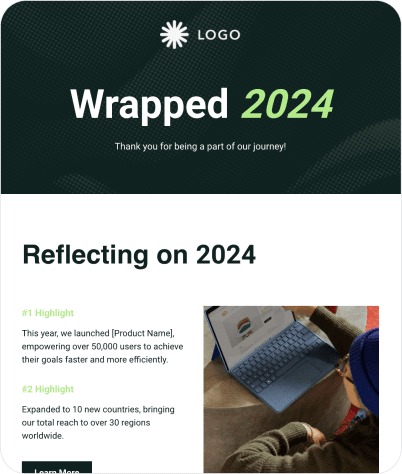
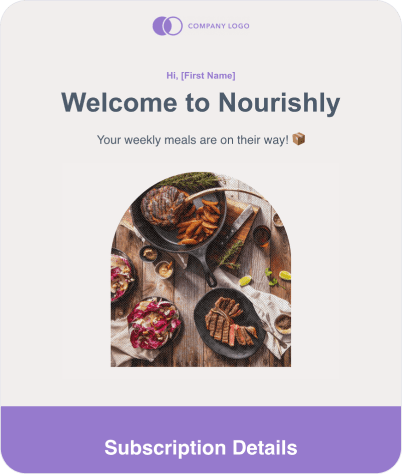
The correct HTML newsletter template will depend on what your goal is. Starting with a template makes it easier to create HTML newsletters consistently while reducing time spent on formatting and layout. Below, we take a look at some newsletter template examples:
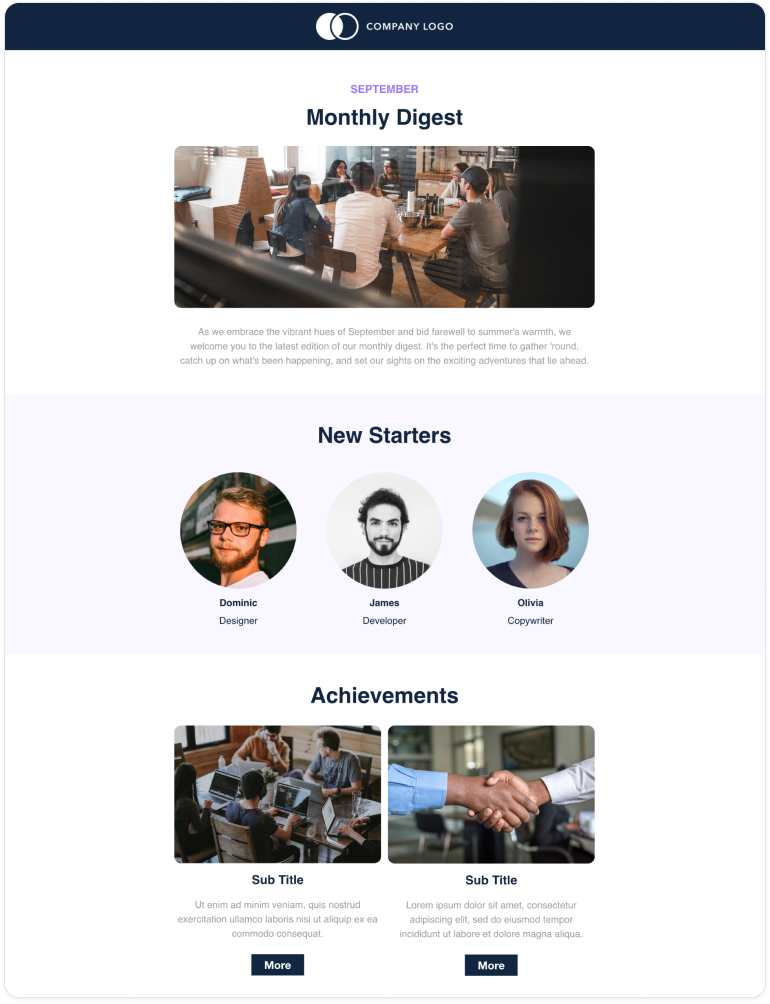

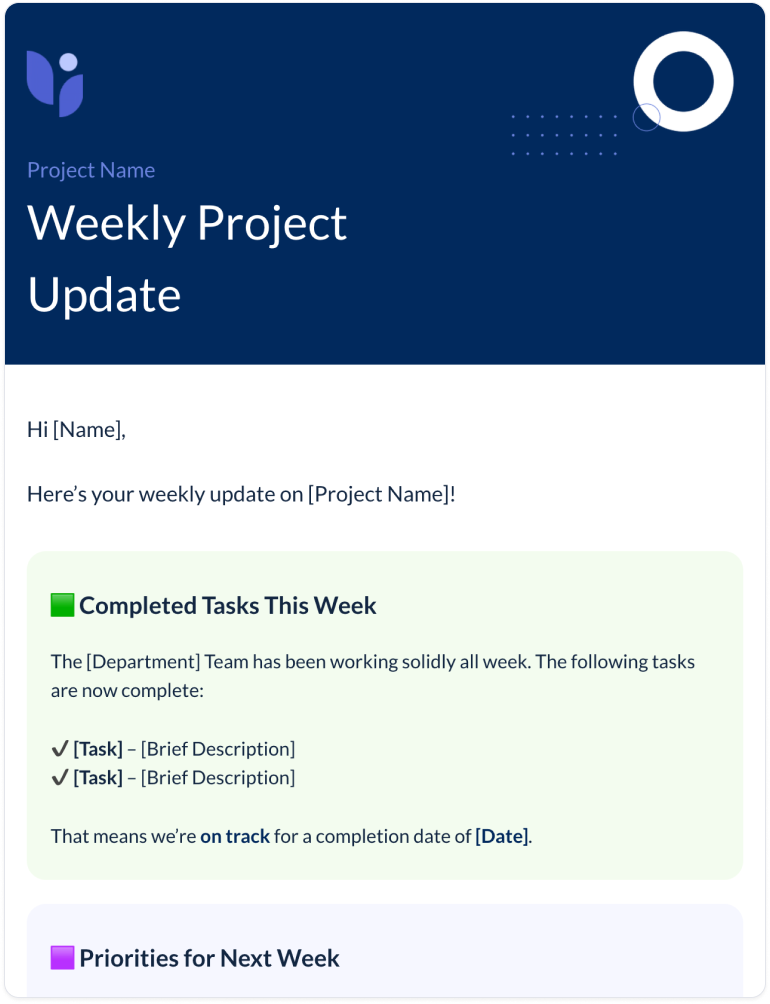


Explore our HTML newsletter templates for more inspiration. Add CTA after this section:
Creating HTML newsletters manually gives teams full control but it also creates more complexity and frustration. Building emails from scratch requires balancing coding, design, testing and ongoing updates across every send.
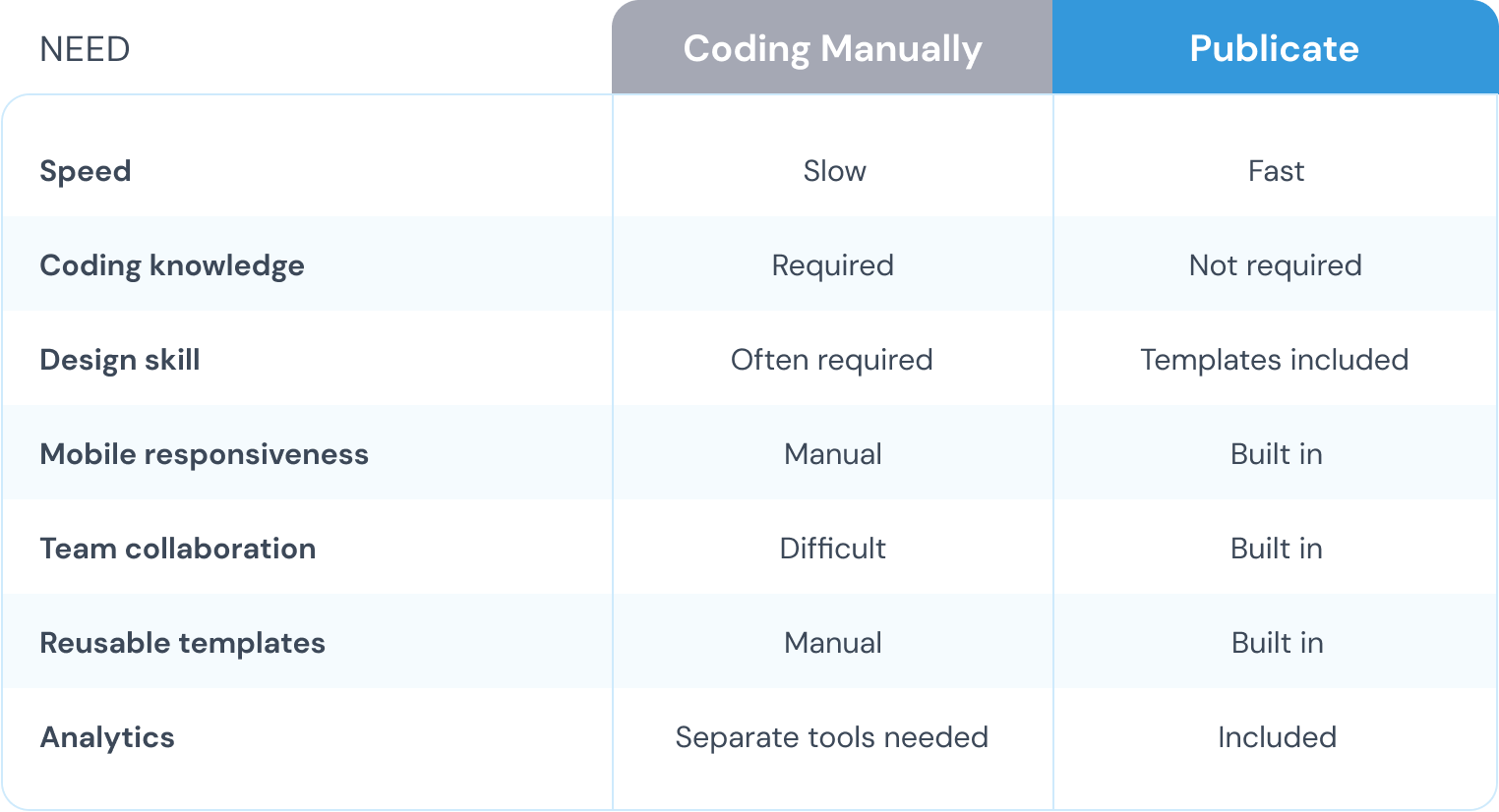
For teams creating newsletters regularly, an HTML newsletter builder will remove the repetitive work that is involved in manual design and creation. Rather than rebuilding layouts and troubleshooting formatting every time, teams can move quickly with reusable templates and workflows designed for email creation.
Creating HTML newsletters manually can be stressful and time-consuming. Coding takes time while manual formatting breaks easily. Over time, inconsistent design can affect engagement and reduce action. A better workflow does not mean you have to compromise on quality. It means creating HTML newsletters in a way that is faster and easier to repeat over time.
With Publicate, teams are able to create branded HTML newsletters visually, reuse layouts, collaborate effectively and send polished and branded emails without relying on manual coding.
Begin your free trial with Publicate today.


Beautiful Designs
Powerful Analytics
Export Emails Anywhere
Built for Teamwork