4DN NEWSLETTER
September 2020

4DN News

4DN Phase II Funded Research Announcements
The first phase of the 4DN program was very successful, but there is still a need to deliver data and tools to the broader biomedical research community to address the role of nuclear organization in health and disease. A second stage of funding for the 4DN program is beginning and funded research groups have started to be announced.

4DN Wiki Update
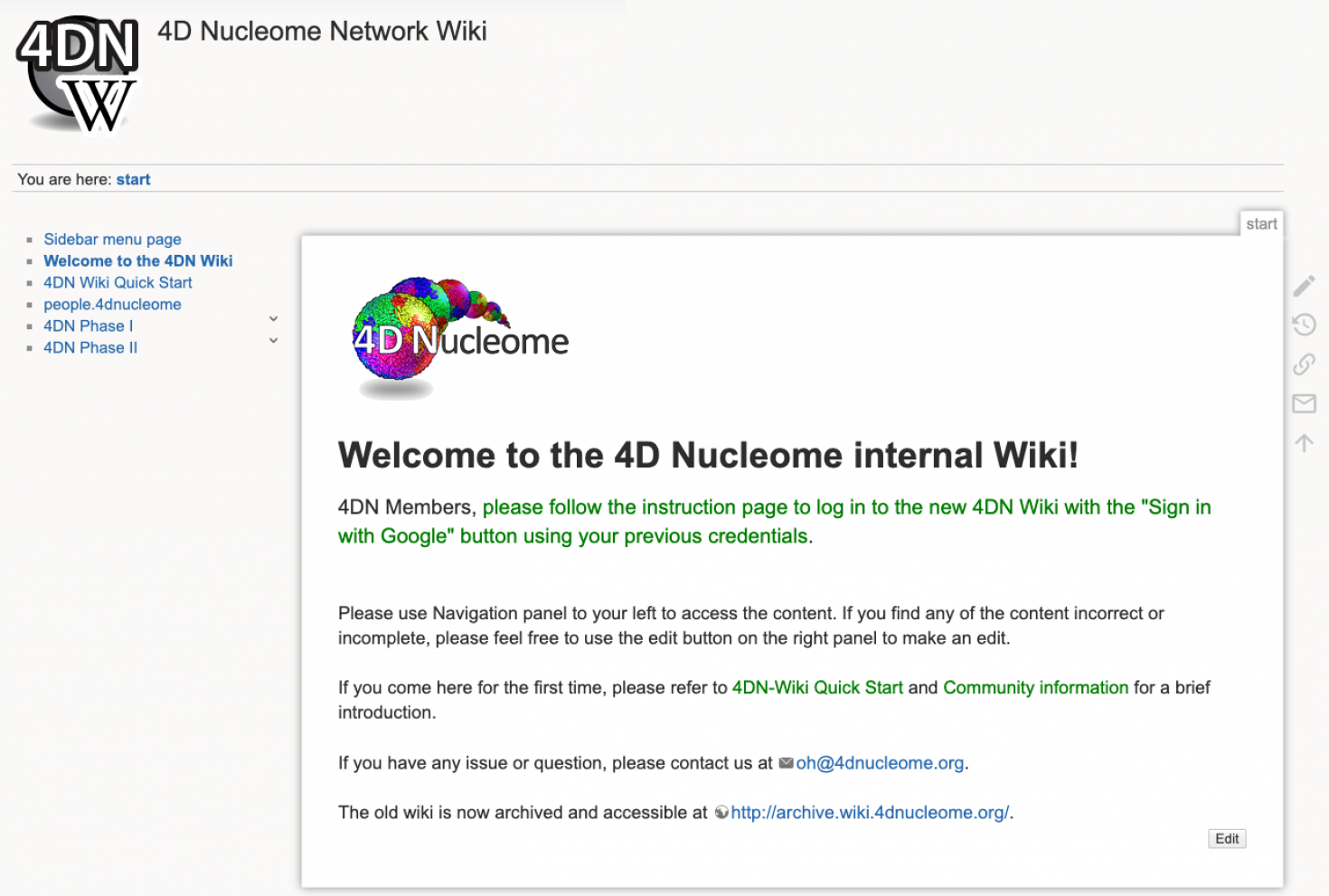
OH began updating the 4DN Wiki to move forward to the Phase II of 4DN. Please avoid using any previously saved bookmark to access any page, given that the Wiki structure is changing and old links will no longer work. During the transition, you should be able to navigate the Wiki as usual using the sidebar.

4DN Publications

Please notify 4DN OH at oh@4dnucleome.org of your new publications and tweet it by tagging us with @4DNucleome.

Your publication will be added to the 4DN Publication Repository accessible from the 4D Nucleome Web Portal.

Two-Color Imaging of Nonrepetitive Endogenous Loci in Human Cells
Ipek Tasan, Christina Jean Su, Behnam Enghiad, Meng Zhang, Shekhar Mishra, Huimin Zhao
 
Tools for live cell imaging of multiple nonrepetitive genomic loci in mammalian cells are necessary to study chromatin dynamics. Here, we report a new system based on two chromosomally integrated orthogonal irregular repeat arrays and particularly a new general strategy to construct irregular repeat arrays. Briefly, we utilized a “bridge oligonucleotide-mediated ligation” protocol to assemble 8-mer repeats de novo which were then combined into a final 96-mer repeat array using Golden Gate cloning. This strategy was used for assembling a new mutant TetO irregular repeat array, which worked orthogonally to the wild type TetO repeat. Single copy integration of the new repeat array did not cause replication deficiencies at the tagged locus. Moreover, the mutant TetO irregular repeat could also be visualized by CRISPR imaging. Our new irregular repeat assembly method demonstrates a generally applicable strategy that can be used for assembling additional orthogonal repeat arrays for imaging genomic loci and irregular repeats to visualize RNA or proteins via signal amplification.

Alteration of genome folding via contact domain boundary insertion
Di Zhang, Peng Huang, Malini Sharma, Cheryl A. Keller, Belinda Giardine, Haoyue Zhang, Thomas G. Gilgenast, Jennifer E. Phillips-Cremins, Ross C. Hardison, Gerd A. Blobel 
 
Animal chromosomes are partitioned into contact domains. Pathogenic domain disruptions can result from chromosomal rearrangements or perturbation of architectural factors. However, such broad-scale alterations are insufficient to define the minimal requirements for domain formation. Moreover, to what extent domains can be engineered is just beginning to be explored. In an attempt to create contact domains, we inserted a 2-kb DNA sequence underlying a tissue-invariant domain boundary—containing a CTCF-binding site (CBS) and a transcription start site (TSS)—into 16 ectopic loci across 11 chromosomes, and characterized its architectural impact. Depending on local constraints, this fragment variably formed new domains, partitioned existing ones, altered compartmentalization and initiated contacts reflecting chromatin loop extrusion. Deletions of the CBS or the TSS individually or in combination within inserts revealed its distinct contributions to genome folding. Altogether, short DNA insertions can suffice to shape the spatial genome in a manner influenced by chromatin context.

Multi-contact 3C reveals that the human genome during interphase is largely not entangled
Filipe Tavares-Cadete, Davood Norouzi, Bastiaan Dekker, Yu Liu, Job Dekker
 
During interphase, the eukaryotic genome is organized into chromosome territories that are spatially segregated into compartment domains. The extent to which interacting domains or chromosomes are entangled is not known. We analyze series of co-occurring chromatin interactions using multi-contact 3C (MC-3C) in human cells to provide insights into the topological entanglement of chromatin. Multi-contact interactions represent percolation paths (C-walks) through three-dimensional (3D) chromatin space. We find that the order of interactions within C-walks that occur across interfaces where chromosomes or compartment domains interact is not random. Polymer simulations show that such C-walks are consistent with distal domains being topologically insulated, that is, not catenated. Simulations show that even low levels of random strand passage, for example by topoisomerase II, would result in entanglements, increased mixing at domain interfaces and an order of interactions within C-walks not consistent with experimental MC-3C data. Our results indicate that, during interphase, entanglements between chromosomes and chromosomal domains are rare.

4DN Pre-prints

Please notify OH (oh@4dnucleome.org) and Riccardo Calandrelli (rcalandrelli@eng.ucsd.edu) to add your pre-print into the 4DN bioRxiv channel and tweet it by tagging us with @4DNucleome.

Your pre-print will be added also to the 4DN Pre-print Repository accessible from the 4D Nucleome Web Portal.

Micromanipulation of prophase I chromosomes from mouse spermatocytes reveals high stiffness and gel-like chromatin organizations
Marko, J. F., Qiao, H., Liu, N., Biggs, R. J., Peng, Y.

10.1101/2020.08.31.276402 - Posted: 2020-09-01

Homeotic Regulation of Olfactory Receptor Choice via NFI-dependent Heterochromatic Silencing and Genomic Compartmentalization
Bashkirova, E., Monahan, K., Campbell, C. E., Osinski, J. M., Tan, L., Schieren, I., Barnea, G., Xie, S., Gronostajski, R. M., Lomvardas, S.

10.1101/2020.08.30.274035 - Posted: 2020-08-30

A dual mechanism of enhancer activation by FOXA pioneer factors induces endodermal organ fates
Geusz, R. J., Wang, A., Lam, D. K., Vinckier, N. K., Alysandratos, K.-D., Roberts, D. A., Wang, J., Kefalopoulou, S., Qiu, Y., Chiou, J., Gaulton, K. J., Ren, B., Kotton, D. N., Sander, M.

10.1101/2020.08.28.263020 - Posted: 2020-08-29

Scientific Webinar Series

We have concluded the Scientific Webinar Series sessions for the first phase of 4D Nucleome. Thank you to all who have presented and joined over the past 5 years!
 
You can find Scientific Webinar presentation slides on the 4DN Wiki. 

Upcoming 4DN meetings (October 2020)

  • October 1 (10am PT, 1pm ET) JAWG
  • October 9 (9am PT, 12pm ET) NOFIC-AICS WG 
  • October 15 (10am PT, 1pm ET) JAWG
  • October 23 (9am PT, 12pm ET) NOFIC-AICS WG
  • October 29 (10am PT, 1pm ET) JAWG

Working Group email lists

  • Policy WG - pubpol@4dnucleome.org
  • Policy WG - pubpol@4dnucleome.org
  • Omics WG - omics@4dnucleome.org
  • Imaging WG - image@4dnucleome.org
  • Data Analysis WG - analysis@4dnucleome.org
  • Outreach WG - outreach@4dnucleome.org
  • Cell Lines WG - cells@4dnucleome.org
  • Joint Analysis WG - meeting-4dn-dj@4dnucleome.org


Stay connected
created in Publicate